Association for Corporate Support of the Arts. - Kigyo Mécénat Kyogikai

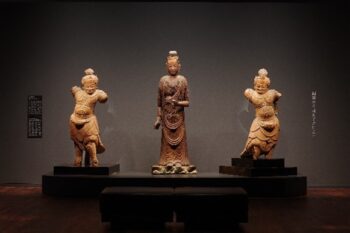 2023 Special Exhibition "Encountering Izu Buddha"
 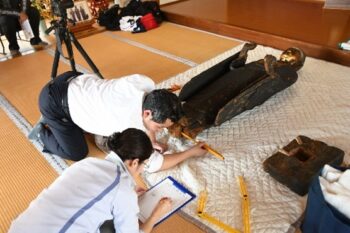 Surveying Buddhist statues at a temple
The Uehara Museum of Buddhist Art, one of the predecessors of the Uehara Museum of Art in Shimoda, Izu, opened in 1983. For the past 40 years, the Uehara Museum of Art has conducted ongoing research into Buddhist culture, including Buddhist statues on the Izu Peninsula. The Amida Triad and Bishamonten (Vaisravana) statue at Kichiden Temple in Matsuzaki Town were rediscovered through our museum’s 1987 survey. After restoration, they were designated as Tangible Cultural Properties of Shizuoka Prefecture, representing exemplary Kamakura-period Buddhist art from Izu. The 26 Heian-period Buddhist statues at the Kawazu Heian Buddha Statue Pavilion have recently attracted nationwide attention. Research by our museum suggests they were created in response to volcanic activity in the Izu Islands. The results of these research activities are introduced annually in our autumn special exhibition and reported in the exhibition catalog. In fiscal year 2022, the Uehara Museum of Art held the special exhibition “Uncrowned Buddhist Statues: Undesignated Cultural Properties of Izu and Eastern Shizuoka.” The wooden statue of the Four-Faced Goddess (Heian period) from Chabatake Sengen- Shrine, unveiled here for the first time, was designated a Cultural Property of Susono City after the exhibition. In fiscal year 2023, the special exhibition “Encountering Izu Buddha” was held. The Uehara Museum of Art will continue to advance research on the Buddhist culture of the Izu Peninsula and Shizuoka.

Association for Corporate Support of the Arts. Kigyo Mécénat Kyogikai “KMK”
Add:5-3-2, Shiba, Minato-ku, Tokyo 108-0014 JAPAN
Tel: +81-(0)3-5439-4520 / Fax: +81-(0)3-5439-4521 / Mail: mecenat@mecenat.or.jp
Business hours Mon-Fri 9:30a.m. to 5:30p.m.
Copyright © 2015 Association for Corporate Support of the Arts. “KMK” All rights reserved.